The short answer
Prepare what your pet already needs—then make it easy to grab.
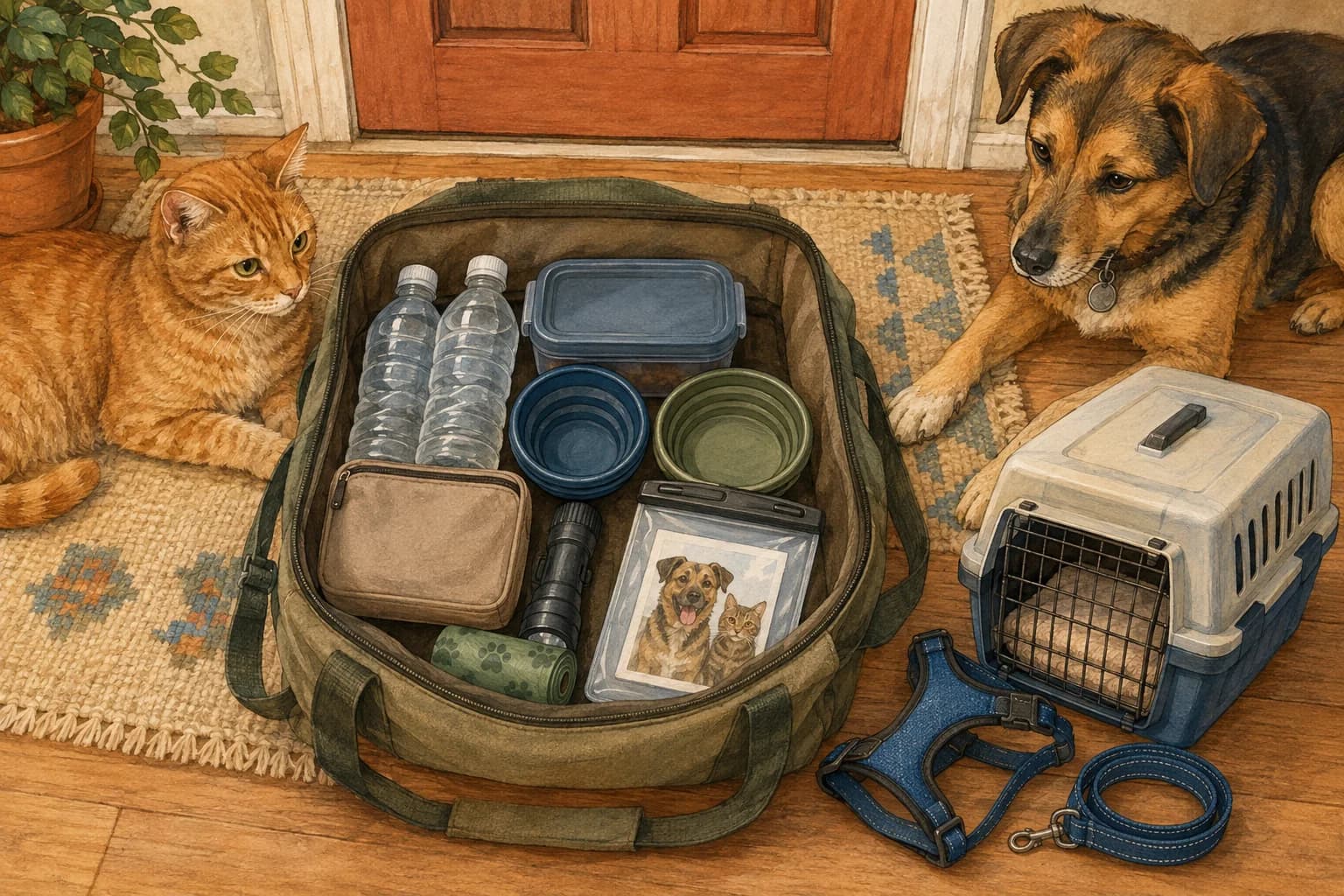
A useful pet emergency kit has current identification and records; a two-week supply of your pet's usual food, water, and prescribed medication; bowls; a leash or harness; one secure carrier per pet; sanitation supplies; and a familiar comfort item. Keep it on your exit route, follow the labeled storage instructions, and practice leaving with it before an emergency.[2][3]
If you only have 10 minutes, do these five things
Check identification
Confirm that collar tags and microchip registration have your current phone number.
Put transport gear by the exit
Set out one correctly sized carrier per pet plus each dog's leash and harness.
Start a waterproof records pouch
Add vaccination records, prescriptions, proof of ownership, and a recent photo of you with your pet.
Write the routine down
Record food amounts, medication names, doses, timing, allergies, and your veterinarian's contact details.
Choose two possible destinations
Identify a pet-friendly place nearby and another outside your immediate area; policies can change, so confirm before leaving.
These steps cover the hardest things to reconstruct under pressure: identity, safe transport, care instructions, and somewhere to go. The CDC also recommends a buddy who can reach and evacuate your pets if you are away.[1]
The complete pet emergency kit checklist
Use a portable, water-resistant bag or bin. Pack for each animal, not just for the household, and use your pet's normal products rather than introducing unfamiliar food during a stressful event.
Identification and records
- Collar with current ID tag, plus a backup collar or harness.
- Microchip number, registry name, and confirmation that your contact details are current.
- Recent clear photos of your pet and at least one photo of you together.
- Vaccination and rabies records, medical summary, prescriptions, and relevant test results.
- Proof of ownership or adoption records.
- Your regular veterinarian, a nearby emergency clinic, a destination-area clinic, and an out-of-area contact.
- Paper copies in a waterproof pouch and secure digital copies you can reach from another device.
Food, water, and medication
- A two-week supply of your pet's regular food, keeping the original packaging inside waterproof containers when possible.
- A two-week supply of water for each animal.
- Non-spill or collapsible bowls and a manual can opener if needed.
- Written feeding instructions, including portions, schedule, allergies, and foods to avoid.
- A two-week supply of prescribed medication when your veterinarian and refill schedule allow.
- Medication name, dose, timing, storage instructions, and veterinary or pharmacy contacts.
The two-week recommendation comes from the CDC's pet disaster checklist. Ask your veterinarian how to plan for controlled, refrigerated, or hard-to-refill medication; do not change a dose or stop treatment to make a supply last longer.[2]
Transport and temporary housing
- One secure, ventilated, correctly sized carrier or transport enclosure per pet.
- A leash and well-fitting collar or harness for every dog, plus backups.
- A familiar towel or washable bedding for each carrier.
- Your name, phone number, and an out-of-area contact attached to each carrier.
- A paper map or written route in case mobile service is unreliable.
Sanitation, comfort, and basic supplies
- Waste bags, paper towels, trash bags, pet-safe cleaning supplies, and disposable gloves.
- Cat litter, a litter pan, and scoop for cats.
- A familiar toy, blanket, or small supply of familiar treats.
- Flashlight and spare batteries.
- A pet first-aid book and a first-aid kit chosen with your veterinarian.
For suspected accidental medication ingestion, use our Apoquel chewable emergency-call guide. Do not delay contacting a veterinarian to finish a packing or handoff checklist.
If someone else must evacuate your pet
Choose a trusted nearby person before an emergency. Confirm that they agree to help, can access your home, and know your pets. The CDC recommends a buddy system; the FDA also recommends giving a temporary caretaker written care instructions.[1][6]
Walk through these five points together, then keep a copy in the records pouch:
- Find and transport each pet: list names, usual hiding places, and the location of carriers, leashes, and the emergency bag. Share home-access details privately with your helper.
- Follow the usual care: write each pet's food portions, allergies, and prescribed medication name, dose, and schedule separately. Use the current veterinary instructions; the helper should not have to guess.
- Retrieve items stored elsewhere: name any refrigerated medication and its exact location. Ask your veterinarian how to transport and store it during an outage.[7]
- Know where to go: include your planned destinations, owner and backup phone numbers, and regular and emergency veterinary contacts.
- Arrange veterinary permission: ask your clinic what authorization it needs if your helper brings the pet. Give the helper signed veterinary-care authorization and a spending limit, as the FDA recommends.[6]
Start with the CDC's printable Pet Boarding Instructions (PDF) for each animal, then add the access, destination, and authorization details above. Update the sheet whenever care changes. Keep completed copies private; they contain personal and medical information. Only attempt pickup when local emergency instructions allow safe access.
Details that are different for dogs and cats
For dogs
- Pack a backup leash and a secure harness, not only a collar.
- Include waste bags and the latest heartworm test or prevention information.
- Practice stairs and getting into the vehicle you would use.
For cats
- Keep the carrier accessible instead of buried in storage.
- Pack a litter pan, litter, scoop, and cleanup bags.
- Know your cat's hiding places and practice calm carrier entry.
Ready.gov recommends a traveling bag, crate, or sturdy carrier for each pet. The CDC also advises labeling each carrier with the pet owner's contact information and practicing carrier use before an emergency.[3][1]
A three-minute evacuation rehearsal
A packed bag does not help if the carrier causes a chase or no one knows who grabs the medication. Practice on a calm day, reward voluntary carrier use, and stop before your pet becomes worried.

- Bring every pet indoors and locate anyone who may hide when frightened.
- Clip on each dog's harness and place each cat or small pet in a secure carrier.
- Pick up the kit and any temperature-controlled medication listed on its reminder note.
- Move to your vehicle or household meeting place using your planned exit.
- Confirm which person would call the destination and which trusted neighbor is your backup.
The CDC recommends that the whole family practice and that pets become familiar with their carriers before an emergency.[1]
Where to store the kit—and when to refresh it
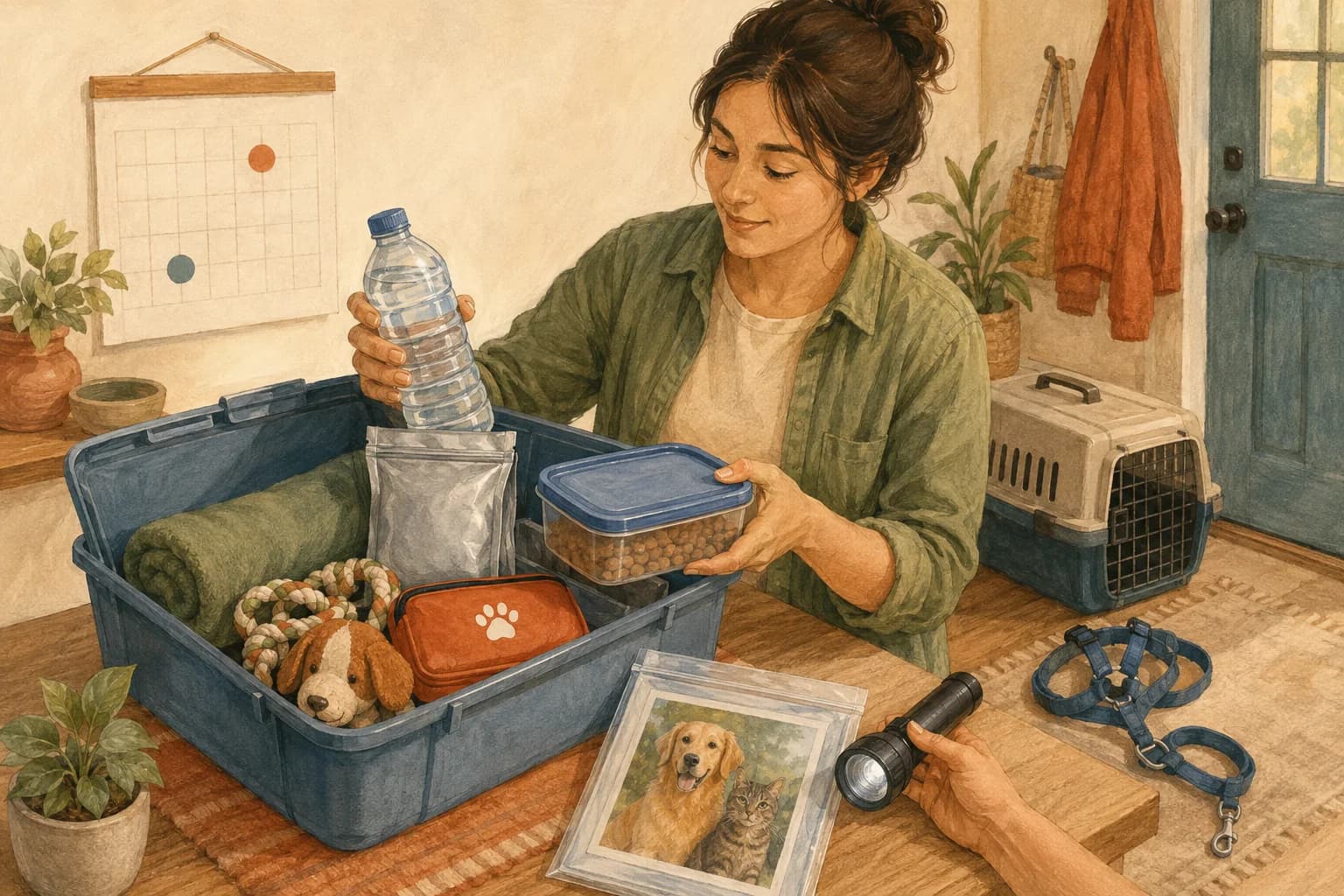
Store the kit somewhere dry and easy to reach. Follow the labeled storage instructions for food and medication, and use a reminder note for anything that must stay refrigerated. Check expiration dates regularly; Merck Veterinary Manual recommends checking medication expiration dates at least once a year.[4]
Keep the food label with the emergency supply
Put the original dry-food bag inside your storage bin. If you must portion food into another container, use a clean, dry one with a fitted lid and attach the product name, manufacturer, UPC, lot number, and best-by date. Replace that information when you change bags, and wash and dry the container between batches. These details let you identify the food if a recall or problem occurs.[9]
FDA recommends keeping dry food and unopened canned food below 80°F in a dry place; a parked car can be a poor permanent storage spot. Follow the product's label, including refrigeration instructions after opening. During each kit refresh, check your supplies against the FDA recall list. Do not feed recalled food, even if it is within its best-by date.[9][10]
Use a simple March-and-September reminder to:
- rotate food and water into normal use before they expire;
- check prescription quantities, expiration dates, and storage instructions;
- test the flashlight and replace weak batteries;
- confirm carrier fit, harness fit, and ID-tag readability;
- update photos, microchip contacts, veterinary records, and lodging options.
What to do when an emergency is happening
- Follow local emergency instructions and leave early when ordered.
- Bring pets inside, secure dogs on leash, and place small pets in individual carriers.
- Call your planned destination to confirm that space and its pet policy are still available.
- Keep pets separated from unfamiliar animals and away from floodwater, debris, chemicals, and downed lines.
- After returning, keep pets restrained while you check the area; familiar scents and landmarks may have changed.
If a pet is injured, has trouble breathing, collapses, overheats, or may have swallowed something dangerous, call your veterinarian or an emergency animal hospital promptly. In the United States, the FDA also lists the ASPCA Animal Poison Control Center at 888-426-4435 and Pet Poison Helpline at 855-764-7661; fees may apply.[5]
Common pet emergency kit questions
How much food and water should be in a pet emergency kit?
The CDC recommends a two-week supply of food and water for each animal. Pack the food your pet already eats, record the normal amount, and rotate sealed supplies before they expire.
Does every pet need a separate carrier?
Plan on one secure, correctly sized carrier or transport enclosure per pet. Frightened animals that normally get along may react differently during an emergency, and individual carriers make a faster, safer evacuation possible.
Where should I store a pet emergency kit?
Keep it somewhere dry and easy to reach on your exit route. Follow the labeled storage instructions for food and medication. If medication must stay elsewhere, put a visible note in the kit saying what to retrieve and where it is stored.
Will an evacuation shelter accept my pet?
Do not assume it will. Pet policies vary, and many evacuation centers do not accept pets other than service animals. Identify pet-friendly lodging, friends or relatives, boarding facilities, or veterinary hospitals before an emergency.
Sources
- Be Prepared: Pet Safety in Emergencies, Centers for Disease Control and Prevention. Accessed September 8, 2026.
- Pet Disaster Kit Checklist, Centers for Disease Control and Prevention. Accessed September 6, 2026.
- Prepare Your Pets for Disasters, Ready.gov. Accessed September 6, 2026.
- First Aid Kit for a Pet, Merck Veterinary Manual. Accessed September 6, 2026.
- Who Do You Call if You Have a Pet Emergency?, U.S. Food and Drug Administration. Accessed September 6, 2026.
- Take Care of Your Pets Before Disaster Strikes, U.S. Food and Drug Administration. Accessed September 8, 2026.
- Saving the Whole Family: Small Animal Evacuation Kit, American Veterinary Medical Association. Accessed September 8, 2026.
- Pet Boarding Instructions, Centers for Disease Control and Prevention. Accessed September 8, 2026.
- Proper Storage of Pet Food & Treats, U.S. Food and Drug Administration. Accessed September 10, 2026.
- About Pet Food Safety, Centers for Disease Control and Prevention. Accessed September 10, 2026.